Top marketing and admissions copywriting tips:
-
Write for your reader, not your institution. Answer the questions students and families are already asking, and make the next step clear.
-
Focus on what families care about most: cost and value, wellbeing and belonging, campus visits, and real student and alumni voices.
-
Speak directly to parents/guardians. They’re co-decision makers and need content written for them, not just forwarded from their student.
-
Tailor your message by grade level. Keep it low-pressure for freshmen and sophomores, focus on cost and visits for juniors, and highlight outcomes (and push the application) for seniors.
-
Get to the point. Trade flowery language for clear, concise copy students can skim and understand quickly.
-
Make it easy to repeat. If a student couldn’t explain your message at the dinner table, simplify it.
-
Swap jargon for everyday words, like “save your spot” instead of “enrollment deposit.”
-
Use Scoir to meet students where they are by personalizing your profile, automating timely messages, segmenting by student interest, and reaching families directly.
Most college marketing communications teams write with good intentions, but sometimes we assume we know what students want to hear, which words land, and what parents/guardians care about. Today's students and families communicate differently, decide differently, and can tell right away when a message wasn't written with them in mind.
At Scoir, we’re learning that small changes make a big difference. Recently, our Client Services and Customer Success teams dug into what content students and families read, remember, and act on.
We’re sharing those findings with you below!
What does audience-first writing look like in college admissions marketing?
Writing to your audience means shaping your message around the person reading it, not the institution sending it. That means speaking their language, answering the questions they're already asking, and making the next step clear.
It’s not about the information you want to get across; it’s about speaking to what they care about. When content truly lands, readers are more likely to engage and take action. They’re more likely to open your messages, click through to learn more, and keep your college on their list.
A few questions to ask as you write:
- Am I using language that will resonate with high school students?
- What does a student really need to know here, and what can I cut?
- How could I reframe this messaging for the parent/guardian audience?
What do students and parents/guardians want to hear from colleges?
In recent research, a few themes come up again and again:
- Cost and value: Families know college is expensive, but they also recognize its worth. Be clear about net price, and show real career outcomes to answer both sides of that question.
- Wellbeing and belonging: Mental health and emotional safety matter to today's students. Highlight wellness resources, community, and what it feels like to belong on your campus.
- Parents/guardians as co-decision makers: Families play a big role in the college decision, and they need relevant content written for them, not just forwarded from their student.
- The campus visit: While virtual tours spark early interest, on-campus visits often seal the deal. Send compelling, personalized follow-up messages even after the visit to keep building on that momentum.
- Authenticity over polish: Day-in-the-life videos and student-created content tend to catch more attention than highly produced institutional videos. Real student and alumni voices build trust.
How should your messaging change by grade level?
A 14-year-old and an 18-year-old are in very different places, so one message won't fit both. Here's a simple way to think about it:
- Freshmen/sophomores: Keep content broad and low-pressure. Show them what they could do with different college majors and share student-produced day-in-the-life videos that illustrate what college life is really like. Point them to your social channels to keep exploring.
- Juniors: Cost and value start to matter more. Highlight scholarship opportunities, net price tools, and campus visit options. Identify your institutional hurdles and address them. For example, if your school isn’t well known for its location, create content showing off the best of your college’s surrounding area.
- Seniors: Share student and alumni stories that show strong career prep and outcomes. Get specific about location and campus culture. Push 👏 push 👏 push 👏 the application.
When should colleges start talking to parents/guardians?
The sooner, the better! Parents/guardians want to be part of the college search. They help their students research schools, request information, and share their perspective along the way. And students listen: on Scoir, students follow 57% of the colleges suggested by a parent/guardian.
The problem is that these influencers often don’t have a clear way into the conversation. Many don’t hear from colleges until after their student applies. Reaching them then can help with yield, but reaching them earlier can help turn interested families into applicants. When you prioritize parent/guardian-specific communications, you’re able to speak directly to what they care about most: cost and financial aid, career outcomes, and campus safety.
Our Parent Handraisers feature makes this easier. Parents/guardians can share their contact information with the colleges they want to hear from, and Scoir sends that information to partner schools. That way, you can reach interested parents/guardians both inside and outside the platform.
How do you write in a way students will actually read, digest, and share?
Get to the point. Gen Z and Gen Alpha value straight talk and can spot fluff quickly. Trade flowery adjectives for direct language and wordy copy for concise messaging.
Here's an example of how to make that shift:
Before: Embark on a transformative journey through the dynamic and ever-expanding world of environmental science, a discipline that stands at the intersection of inquiry and impact. As our planet faces unprecedented challenges and our collective awareness of ecological interdependence deepens, environmental science remains vital to shaping a more sustainable future.
After: Environmental science helps you understand how natural systems work and what’s putting them at risk. You’ll study biology, chemistry, and data analysis, then use those skills in field research and real conservation projects.
Same message but with fewer words, so students can skim quickly and understand easily.
Make it easy to repeat. Students talk through their college options with their families, counselors, and friends. If they don't understand what you’re trying to convey, they can't share it. Ask yourself: could a student explain this at the dinner table?
What words and phrases should colleges avoid?
Students tend to skip content that feels too formal. If you're not sure whether a student will understand a word or phrase, they probably won't (especially not when skimming). Here are some simple swaps:
Intead of...
|
Try...
|
| Experiential learning |
Real-world experience |
| Don't leave money on the table |
Don't miss out on scholarships |
| If you're unsure about your finances |
If you're not sure about cost |
| Liberal arts education |
A quick explanation of what it means (e.g., "You'll explore many subjects while building skills like writing and problem-solving.") |
| Matriculate |
Start classes, join us this fall |
| Enrollment deposit |
Save your spot |
| Holistic review |
We look at more than grades and test scores |
How can you put this into practice in Scoir?
1 in 8 college-bound students use Scoir as their main college search tool, working alongside their school counselor. They come from more than 2,300 high schools. Here’s a snapshot of Scoir’s reach:
- 66% of the top 1,000 private high schools use Scoir
- 40% of all private high schools use Scoir
- 51% of the top 1,000 public high schools use Scoir
- 34% of high schools on Scoir are Title I–eligible
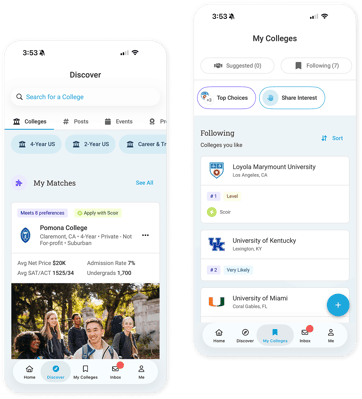
Scoir offers partner colleges several ways to build meaningful connections with students and families. Here are a few of our top tips for meeting students where they are in the platform:
- Personalize your Scoir profile. Share programs, student life, and outcomes in short, digestible language.
- Set up concise automated messages. When a student follows your college, marks that they're applying, or has applied, your message should match that moment and make their next step clear.
- Segment your messages. A freshman exploring options shouldn’t get the same academics message as a junior interested in biology. Personalize your content to be more relevant to each student you’re speaking to.
- Connect with parents/guardians. Message families directly about what they’re interested in: cost, outcomes, support resources, etc.
Don’t have the bandwidth to make these impactful changes or implement segmentation? Consider working with Scoir’s Client Services team! They’ll manage your Scoir plan for you.
And if you’re not a Scoir partner yet, book a demo to learn more about how you can connect with students and families who are already interested in your college.
Noelle is a Content & Engagement Strategist working on both the Client Services and Marketing teams at Scoir. She has over eight years of higher education experience as both a writing instructor and in marketing communications. Her North Star goal as a writer is to create meaningful connection.
 Noelle Brandon



 Noelle Brandon: October 14, 2026
 Valerie Russell